Square Kids Book Mockup: A Practical Evaluation for Designers and Marketers
In the competitive landscape of children's publishing and digital design, the ability to present a concept with clarity and visual appeal is paramount. For artists, illustrators, and marketing professionals, the Square Kids Book Mockup has emerged as a critical tool in the pre-production and presentation phase. Unlike standard rectangular formats that dominate traditional bookshelves, square books offer a unique canvas that demands specific visualization strategies. This mockup solution provides a high-fidelity 3D render designed to bridge the gap between a flat digital file and a tangible product representation.
The utility of this resource lies not just in its aesthetic quality, but in its technical specifications tailored for professional workflows. With included formats ranging from 4000 x 3200 pixels to an expansive 10000 x 8000 pixels, both at 300 DPI, it addresses the dual needs of web-based presentations and high-resolution print materials. However, before integrating this asset into a workflow, it is essential to understand its distinct characteristics, how it compares to alternative visualization methods, and the specific scenarios where it offers the most value.
Defining the Square Format and Its Visualization Needs
To appreciate the Square Kids Book Mockup, one must first recognize the unique challenges of the square format itself. While standard trade paperbacks typically adhere to ratios like 6x9 or 5x8 inches, square books (often 8x8 or 10x10) are prevalent in children's literature due to their suitability for large illustrations and interactive layouts. This geometry changes how light hits the cover, how the spine interacts with the pages, and how the book sits on a shelf or in a child's hands.
A generic rectangular mockup often fails to capture these nuances. When a designer attempts to force a square design onto a rectangular template, the result can look distorted or unprofessional. The Square Kids Book Mockup is distinct because it is engineered specifically for this geometry. It accounts for the symmetrical balance of the cover and the specific curvature of the edges when the book is closed. This precision is vital for clients who need to visualize the final product accurately before committing to printing costs.
Technical Specifications and Workflow Integration
The effectiveness of any digital asset depends heavily on its resolution and file format. The Square Kids Book Mockup distinguishes itself through its robust technical deliverables. The inclusion of a 10000 x 8000 pixel PNG file at 300 DPI is particularly significant for professionals working in print advertising or large-format displays. At this resolution, designers can zoom in significantly without encountering pixelation, ensuring that textures, typography, and illustration details remain crisp.
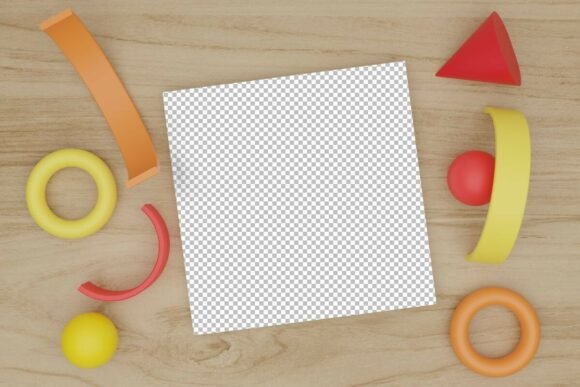
For those whose primary focus is digital marketing, social media campaigns, or email newsletters, the 4000 x 3200 pixel option provides a balanced approach. It offers sufficient detail for high-quality screens while maintaining manageable file sizes for faster loading times. The use of PNG format ensures transparency, allowing the mockup to be seamlessly integrated into various background environments, such as a cozy reading nook, a classroom setting, or a clean studio backdrop.
This flexibility reduces the need for additional rendering software. Instead of spending hours configuring lighting and camera angles in complex 3D applications, a user can simply apply their design to the smart object layer within the provided file. This efficiency is a major trade-off consideration: while dedicated 3D software offers infinite customization, the Square Kids Book Mockup prioritizes speed and ease of use, making it ideal for rapid prototyping and client reviews.
Comparing Static Mockups Against Dynamic Alternatives
When evaluating resources for showcasing book designs, the Square Kids Book Mockup exists within a broader ecosystem of tools. On one end of the spectrum are fully dynamic 3D modeling programs like Blender or Cinema 4D. These tools allow for complete control over every aspect of the scene, including custom lighting, physics simulations, and camera movements. They are powerful but require a steep learning curve and significant time investment.
On the other end are simple photo editing overlays that lack depth or realistic shading. These are quick to use but often fail to convey the tactile quality of a physical book. The Square Kids Book Mockup occupies a strategic middle ground. It offers the realism of a 3D render without the complexity of 3D modeling software. It is pre-configured with realistic shadows, reflections, and paper textures that mimic the actual feel of a printed book.
For a freelancer managing multiple client projects simultaneously, the time saved by using a high-quality static mockup versus building a scene from scratch is substantial. However, if a project requires a highly stylized, animated video presentation of the book opening page-by-page, this static PNG solution would not suffice. In such cases, a motion graphics approach would be necessary. Therefore, the decision to use this mockup should hinge on the specific deliverable required: a static image for a portfolio or pitch deck versus an animated experience for a website hero section.
Evaluating Use Cases: When to Choose This Resource
The Square Kids Book Mockup is particularly well-suited for several specific scenarios. First, it is an excellent choice for authors and illustrators self-publishing children's books. These creators often work with limited budgets and need to present professional-grade visuals to potential buyers or crowdfunding supporters. The high resolution allows them to create compelling images for Kickstarter campaigns or Amazon product listings that compete with traditionally published titles.
Secondly, marketing agencies specializing in educational products will find this resource invaluable. When pitching a new series of activity books or storybooks to school districts or retailers, the visual presentation must be flawless. The square format is common in early education materials, and having a mockup that accurately represents the size and shape helps stakeholders visualize the product in a real-world context, such as on a teacher's desk or in a library bin.
Conversely, there are situations where this specific mockup may not be the right fit. If a designer is working on a textbook, a novel, or a non-fiction guide, the square dimensions will not align with the standard industry norms for those genres. Using a square mockup for a rectangular book design would mislead the client regarding the final product's proportions. Additionally, if the design involves complex die-cuts, pop-up mechanisms, or foil stamping that alters the surface texture significantly, a standard flat mockup might not capture these special effects accurately without manual adjustment.
Tradeoffs and Decision Factors for Professionals
Selecting the right visualization tool involves weighing convenience against customization. The primary strength of the Square Kids Book Mockup is its "plug-and-play" nature. It democratizes high-end visualization, allowing designers without advanced 3D skills to produce photorealistic results. This lowers the barrier to entry and accelerates the feedback loop between designer and client.
However, the tradeoff is a degree of rigidity. Once the lighting and angle are set in the render, they cannot be changed. If a client requests a version of the book under warm sunset lighting or viewed from a top-down perspective, the current mockup cannot accommodate that request without creating a new file. In contrast, a 3D model can be re-lit and re-angled instantly. Therefore, users should consider whether their project requires a single, perfect shot or a suite of variations.
Another factor is the target audience's perception. In the world of children's books, the emotional connection is key. A high-quality mockup that shows the book sitting invitingly on a wooden table can evoke a sense of warmth and playfulness that a flat JPEG cannot. The Square Kids Book Mockup excels in this emotional resonance, providing a context that suggests the book is already part of a child's life.
Conclusion: Making an Informed Choice
The Square Kids Book Mockup represents a specialized solution for a specific segment of the design market. Its combination of high resolution, accurate geometry, and ease of use makes it a powerful asset for anyone working with square-format children's literature. It effectively bridges the gap between raw design files and market-ready imagery, offering a level of professionalism that is essential for modern publishing.
While it may not replace the need for full 3D animation or customized modeling in every scenario, it serves as an efficient, cost-effective alternative for the majority of static presentation needs. By understanding its strengths—such as the 300 DPI clarity and realistic rendering—and acknowledging its limitations regarding fixed angles and lighting, designers can make informed decisions about when to deploy this tool. Ultimately, the goal is to present the best possible vision of the book, and for square formats, this mockup provides a reliable and polished foundation upon which to build that vision.