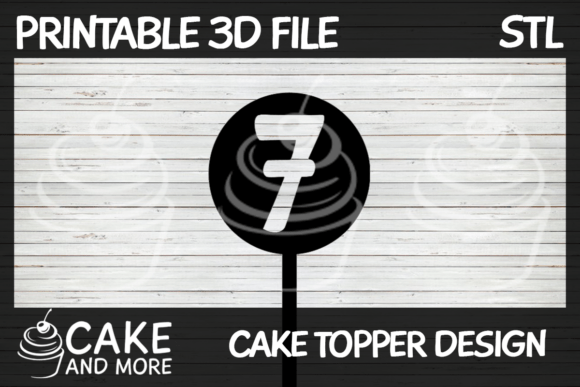
Number 7 Cake Topper: A Practical Guide to 3D Printed Celebration Decor
The seventh birthday often marks a significant transition in a child's life, moving from early childhood into the more independent years of middle childhood. For parents and event planners seeking a memorable yet practical way to mark this milestone, the Number 7 Cake Topper has emerged as a versatile solution. Unlike traditional flat cardboard cutouts or mass-produced plastic decorations, a 3D printable version offers a unique blend of customization, durability, and aesthetic depth. This article evaluates the utility, design considerations, and comparative advantages of using a downloadable STL file for creating a custom Number 7 Cake Topper.
Understanding the Value of a 3D Printable Design
At its core, a Number 7 Cake Topper in digital format is a blueprint for physical creation. The provided STL file represents a geometric model optimized for additive manufacturing. What distinguishes this approach from buying a pre-made item is the control it grants the creator over material choice, scale, and finish. When you download an STL file, you are not purchasing a static object; you are acquiring the capability to produce one tailored precisely to your specific cake dimensions and thematic requirements.
This method aligns with the growing trend of maker-culture celebrations, where personalization extends beyond simple color choices to include structural design. A 3D printed topper allows for intricate details that are difficult to achieve with standard injection molding used in retail products. The ability to print in various materials—from biodegradable PLA to durable PETG—means the decoration can be designed for single-use elegance or long-term keepsake quality.
Comparing Formats: Digital Files vs. Pre-Made Retail Options
When evaluating options for a seventh birthday celebration, consumers typically weigh three primary categories: pre-made store-bought toppers, DIY craft kits, and 3D printable files. Each presents distinct tradeoffs regarding cost, time investment, and final quality.
Pre-made Retail Toppers offer immediate gratification. They are inexpensive and require no technical skill. However, they often suffer from limited color palettes, generic designs, and fragile construction. A plastic number seven bought at a discount store may warp under the heat of candles or appear thin and insubstantial next to a professionally decorated cake.
DIY Craft Kits, such as felt or fondant templates, provide a hands-on experience but demand significant manual dexterity and time. Achieving a clean, symmetrical "7" with these materials can be challenging for those without crafting experience. Furthermore, the longevity of these items is often low; they are rarely reusable and can degrade quickly if exposed to moisture or handling.
In contrast, the Number 7 Cake Topper STL file occupies a middle ground that favors quality and customization. While it requires access to a 3D printer (or a service bureau), the resulting object is structurally robust. The 3D nature of the print adds visual weight and presence to the dessert. Unlike a flat cutout, a 3D printed number casts shadows and reflects light differently, adding a layer of sophistication that elevates the overall presentation of the cake. For adults aged 20 to 50 who value efficiency and high-quality outcomes, the initial learning curve of 3D printing is often outweighed by the superior aesthetic result.
Evaluating Technical Requirements and Compatibility
Before committing to a 3D printable design, it is essential to assess the technical feasibility. The versatility of the Number 7 Cake Topper lies in its compatibility with both Fused Deposition Modeling (FDM) and Stereolithography (SLA/Resin) printers, though the output differs significantly between the two.
- FDM Printers: These are common desktop machines that extrude thermoplastic filament. They are ideal for larger prints and are generally more affordable to operate. An FDM-printed Number 7 will have visible layer lines, which can add a textured, industrial charm. If smoothness is a priority, post-processing such as sanding or priming is recommended. FDM is best suited for users who prioritize speed and material strength.
- Resin Printers: These use liquid photopolymer resin cured by UV light. They produce exceptionally smooth surfaces with fine detail, making them perfect for delicate, elegant designs. A resin-printed topper often requires less post-processing to look professional immediately. However, resin printing involves more complex safety protocols regarding ventilation and skin contact.
For most home users, the decision hinges on available equipment. If you do not own a printer, many online services allow you to upload the STL file and receive a finished product. This hybrid approach retains the benefits of custom sizing without requiring hardware ownership.
Scalability and Design Flexibility
One of the most compelling arguments for using a digital Number 7 Cake Topper is scalability. Standard retail toppers come in fixed sizes, which can lead to awkward proportions if the cake is unusually large or small. With an STL file, the design can be scaled up or down within the slicing software before printing.
This flexibility ensures the topper remains proportional regardless of the cake's diameter. For instance, a towering tiered cake might require a number seven that is six inches tall to maintain visual balance, whereas a cupcake might need a miniature version. The ability to adjust dimensions digitally eliminates the risk of the decoration looking out of place. Additionally, some advanced users choose to modify the geometry itself, perhaps thickening the base for better stability or altering the font style slightly to match a specific theme, such as a futuristic or vintage aesthetic.
Material Considerations and Food Safety
A critical factor in choosing a 3D printed topper is food safety. It is important to note that standard 3D printing filaments and resins are not inherently food-safe, especially when printed on consumer-grade machines. Microscopic crevices between layers can harbor bacteria, and some materials may leach chemicals when in contact with frosting or moisture.
To mitigate these risks, the Number 7 Cake Topper should ideally be treated as a decorative element rather than a direct food contact surface. Best practices include:
- Using a dedicated skewer or pick to insert the topper into the cake, ensuring the plastic does not touch the edible portion directly.
- Applying a food-safe sealant or epoxy coating to the printed object to create a non-porous barrier.
- Removing the topper before serving slices of the cake.
While this adds a step to the process, it ensures that the celebration remains safe for all guests. For those unwilling to manage these precautions, purchasing a commercially certified food-safe topper made from acrylic or stainless steel might be a safer alternative, though it lacks the customization potential of the 3D printed option.
Decision Factors: When to Choose a 3D Printable Topper
Determining whether a Number 7 Cake Topper STL file is the right choice depends on several variables. It is an excellent fit for individuals who enjoy the creative process, have access to printing resources, or desire a unique aesthetic that mass-market goods cannot provide. It is particularly well-suited for milestone birthdays where the decoration serves as a keepsake or a focal point for photography.
However, if time is extremely limited or if the user has no access to a printer or printing service, the logistical hurdles may outweigh the benefits. In scenarios where a quick, disposable decoration is needed for a casual gathering, a pre-made option remains the most pragmatic choice. Similarly, for events with strict dietary regulations or where food contact is unavoidable, certified food-grade materials may be preferable to DIY 3D prints.
Conclusion
The Number 7 Cake Topper represented by a downloadable STL file offers a sophisticated alternative to traditional party supplies. By bridging the gap between digital design and physical reality, it empowers creators to produce high-quality, scalable, and personalized decorations. While it requires a willingness to engage with 3D printing technology and adhere to food safety guidelines, the result is a distinctive centerpiece that enhances the celebratory atmosphere. For those willing to invest the effort, the ability to customize size, material, and finish makes the 3D printed route a superior choice for marking the seventh year of life with style and precision.