Evaluating the Laser Cut Rocking Toy Bunny Deer for Holiday Crafting
The intersection of traditional craftsmanship and modern digital fabrication has opened new avenues for creating personalized holiday decorations. Among the growing library of digital designs available to makers, the Laser Cut Rocking Toy Bunny Deer stands out as a distinctive project that combines whimsical character design with mechanical movement. This article provides an objective evaluation of this specific laser-cut file, examining its technical requirements, aesthetic appeal, and practical considerations for both novice and experienced crafters.
Understanding the Design Concept
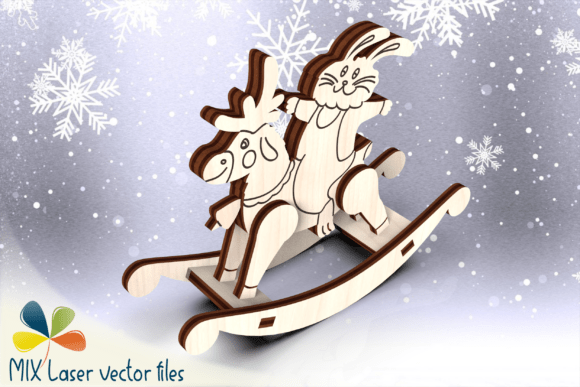
The core concept behind this project is a layered, kinetic sculpture featuring a cheerful bunny riding a friendly reindeer. Unlike static ornaments, this design incorporates a rocking mechanism, allowing the figure to move gently when placed on a flat surface. The visual appeal relies heavily on the layering technique, where multiple sheets of material are stacked to create depth and a three-dimensional effect. This approach transforms flat materials into a volumetric object, adding a sense of motion and charm that static cutouts often lack.
For those researching holiday décor options, this design offers a blend of nursery-friendly aesthetics and festive symbolism. The combination of a bunny and a reindeer bridges the gap between general childhood whimsy and specific Christmas traditions, making it versatile for various decorative contexts. It is not merely a ornament but a small-scale mechanical toy, which adds an interactive element to home displays.
Technical Specifications and Material Requirements
Before committing to this project, it is essential to understand the technical constraints. The finished dimensions of the assembled toy are approximately 100 mm in length, 30 mm in width, and 80 mm in height (roughly 3.9 x 1.2 x 3.1 inches). These compact proportions make it suitable for shelf displays, mantlepieces, or as part of a larger centerpiece arrangement.
The design is optimized for a material thickness of 3 mm. This is a critical specification because the interlocking joints and rocking mechanism rely on precise friction fits. Using material that is significantly thicker or thinner than 3 mm may result in parts that are either too tight to assemble or too loose to hold together securely. Common materials that meet this requirement include plywood, MDF, acrylic, and heavy cardstock, though wood products generally provide the structural integrity needed for the rocking function.
The file formats provided typically include SVG, PDF, DXF, AI, and CDR. This broad compatibility ensures that users can work with their preferred software, whether they are using professional vector editing tools like Adobe Illustrator or more accessible platforms like Inkscape or CorelDRAW. The availability of multiple formats reduces barriers to entry for hobbyists who may not have access to expensive industrial software.
Benefits and Aesthetic Appeal
One of the primary benefits of choosing the Laser Cut Rocking Toy Bunny Deer is its ability to add dynamic movement to static holiday displays. The rocking action captures attention and adds a playful energy to a room. For parents or educators, this can serve as a gentle introduction to mechanics and physics for children, demonstrating how balance and curvature influence motion.
From a decorative standpoint, the layered design creates shadows and depth that change depending on the lighting angle. This visual complexity elevates the piece above simple flat cutouts, giving it a handcrafted, premium appearance. Additionally, because the design is digital, it allows for customization. Makers can choose different wood stains, paint colors, or even mix materials to match specific interior design themes, ranging from rustic farmhouse to modern minimalist.
Tradeoffs and Practical Considerations
While the design is appealing, there are tradeoffs to consider. The assembly process requires patience and precision. Since the toy consists of multiple layers, aligning them correctly is crucial for both the aesthetic outcome and the functional rocking mechanism. Misalignment can cause the toy to lean unevenly or fail to rock smoothly. Therefore, this project may not be ideal for individuals seeking a quick, five-minute craft solution.
Another consideration is the limitation of the rocking mechanism itself. As a small, lightweight object, the toy requires a perfectly flat and stable surface to function correctly. It may not perform well on textured surfaces, carpets, or uneven tables. Furthermore, due to its small size and potential for small detached parts during assembly, it should be kept out of reach of very young children who might attempt to disassemble or ingest components.
Makers must also account for the kerf—the width of the cut made by the laser beam. If the laser settings are not calibrated correctly for the specific 3 mm material being used, the joints may be too loose or too tight. Test cuts are highly recommended before cutting the final pieces to ensure a proper fit.
Ideal Use Cases
This project is a strong fit for several specific scenarios:
- Handmade Gift Giving: The unique nature of a handmade, kinetic toy makes it a thoughtful gift for friends and family who appreciate craftsmanship. It is particularly suitable for new parents or grandparents looking for non-electronic toys.
- Nursery and Playroom Décor: The gentle imagery and soft motion align well with calming environments for children. It serves as a decorative accent that is also engaging for older toddlers under supervision.
- Holiday Craft Workshops: For community centers or schools with access to laser cutters, this project offers a manageable yet impressive result for participants. It teaches basic assembly skills and introduces the concept of kinetic art.
- Small Space Decoration: Its compact footprint makes it ideal for apartments or offices where large Christmas trees or extensive decorations are not feasible.
When to Consider Alternatives
Despite its charms, the Laser Cut Rocking Toy Bunny Deer may not be the right choice for everyone. If you are looking for large-scale outdoor decorations, this design is too small and delicate to withstand weather conditions. Similarly, if you do not have access to a laser cutter or a service that can cut 3 mm materials accurately, the project may prove difficult to execute using manual tools like scroll saws, which struggle with the intricate internal cuts required for the layers.
Additionally, if your goal is to create durable heirloom pieces that will withstand rough handling, you might consider designs made from solid wood blocks rather than layered laminates. While the layered look is attractive, the glued joints can be vulnerable to impact over time.
Final Decision-Making Insights
Choosing to create the Laser Cut Rocking Toy Bunny Deer should depend on your interest in kinetic crafts and your access to precise cutting technology. It is best suited for makers who enjoy the assembly process and value the aesthetic of layered wood or acrylic. The project offers a rewarding balance of challenge and accessibility, providing a tangible result that brings joy through both its appearance and its movement.
By carefully selecting high-quality 3 mm material and taking the time to calibrate your laser settings, you can produce a charming piece of holiday magic that stands out for its ingenuity and warmth. Whether used as a standalone display item or part of a broader festive arrangement, this rocking toy exemplifies how digital design can enhance traditional crafting with motion and personality.